
Cabled right.
Tested. Labeled.
Cat6/Cat6A data, fiber, and AV cabling for offices, light industrial, healthcare, and high-end residential. Designed, labeled, and tested properly.
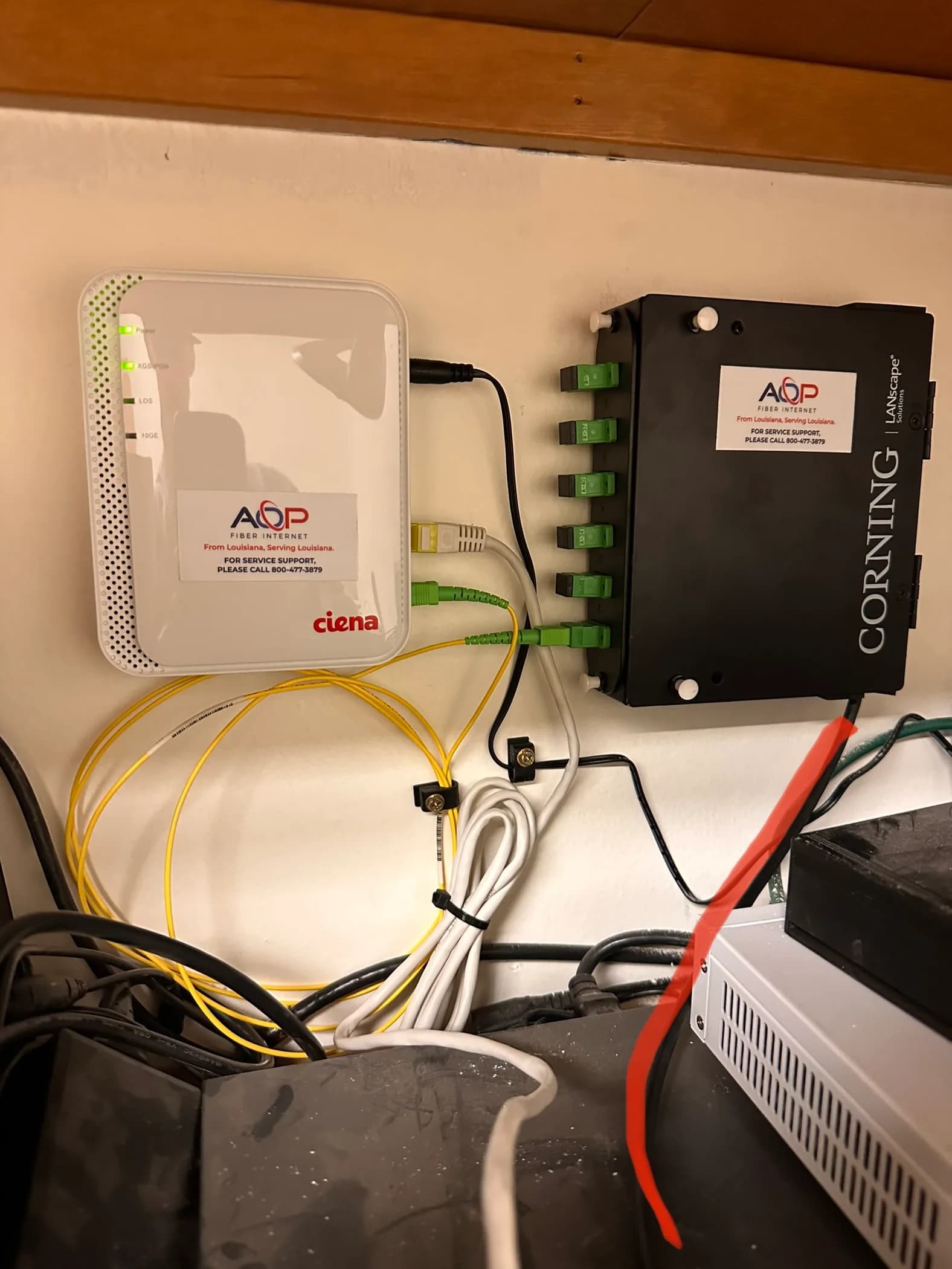
Modern buildings live or die on their low-voltage backbone.
Cabling is the part of your building you don’t see and you don’t think about — until it doesn’t work. Then suddenly the conference room is flickering, the WiFi is unreliable in the corner office, the printer drops the print job halfway through, and IT spends a half-day chasing a phantom. Most of those phantoms trace back to bad cabling — under-spec wire, kinked runs, terminations done by someone in a hurry, or a labeling system that doesn’t match anything in the rack.
We design and install structured cabling that doesn’t do that. The cable is rated for the run length and the application. The terminations are punched, dressed, and tested. The patch panel mirrors the wall plates. Every cable is labeled at both ends. And every run gets certified by a professional cable certifier before we leave the site.
What we install
- Cat6 UTP — standard for office TI, supports 1 Gbps full 100m, 10 Gbps for shorter runs (~55m). Plenum or riser rated as required.
- Cat6A STP/UTP — full 10 Gbps to 100m, shielded for high-density and noisy environments. Standard for healthcare, server rooms, and high-density open-plan offices.
- Single-mode fiber — long-distance backbone, building-to-building, up to 10+ km. OS2 grade, LC or SC terminations.
- Multimode fiber — within-building backbone and rack uplinks. OM3 and OM4. Higher bandwidth, shorter distances.
- Coax — RG6 and RG11 for video distribution and CCTV where needed.
Termination, dressing, and labeling
The visible part of the install is what most customers grade us on. We do it like this:
- Patch panel work is dressed left-to-right or top-to-bottom, with all jacket lengths matched and Velcro-strapped (not zip-tied — Velcro lets us add cables later without re-cabling)
- Cable management on both sides of the rack — horizontal and vertical managers properly populated
- Labels printed on label printer (P-Touch or equivalent), not Sharpie
- Wall-plate labels match patch-panel labels match the as-built drawing
Testing — every cable, every run
Cable certification isn’t the same as cable verification. A continuity tester (the cheap blue plastic thing) tells you the wires are connected. A certifier tests for length, attenuation, NEXT, return loss, and category compliance — meaning it tells you whether the cable will actually carry the speed it’s rated for under the actual conditions of the install.
We certify-test every cable we install. If a run doesn’t pass, we re-pull or re-terminate before we leave. The test report — every run, every parameter — goes in your closeout file. That’s the difference between a cable plant that works on day one and one that’ll still work in five years when the load doubles.
What a typical project looks like
- Walk-through with you and your IT/AV partner — count drops, sketch run paths, locate the rack
- Quote — itemized by drop, by panel, by fiber run, by labor
- Schedule — typically 1–3 days for a small office, 1–2 weeks for a larger TI
- Pre-wire — we pull cable during the framing/rough-in phase if it’s a buildout, or after-hours if it’s an active office
- Termination — patch panel, jacks, and any fiber terminations
- Test — every cable certified, every run reported
- Trim — wall plates, labels, dress the rack
- Closeout — test report, cable schedule, as-built
Pricing
Cabling is usually quoted per drop with line items for fiber, AV, and special terminations:
- Standard Cat6 drop (jack at the wall, terminated patch panel, certified): $180–$300/drop in active office settings, $100–$220/drop on new construction
- Cat6A: add roughly 25–35% to the per-drop price
- Multimode fiber pair, terminated and tested: $325–$475/pair installed
- Patch panel and rack hardware: Quoted with the project
- Cable cleanup / re-labeling existing rack: Quoted per rack — usually 4–8 hours for a typical small-business rack
Common cabling myths.
All Cat6 cable is the same.
Real Cat6 has 23 AWG copper conductors with a tight twist rate and meets TIA-568 specs. Cheap online 'CCA' (copper-clad aluminum) cable looks identical and even labels itself Cat6 — but it can't pass certification testing past short distances. Insist on solid copper, plenum/riser-rated where required.
If a cable shows continuity, it's good.
A continuity tester only confirms wires are connected end-to-end. It says nothing about whether the cable will carry the speed it's rated for under real load. That's why we certify-test with a professional cable certifier — it measures attenuation, NEXT, and category compliance, not just connectivity.
WiFi has replaced the need for ethernet drops.
WiFi handles convenience, not capacity. Hardwired ethernet is still 5–10× faster, more reliable, and doesn't share bandwidth with everyone else on the network. Modern offices and homes increasingly run BOTH — WiFi for mobile, ethernet for everything that stays put.
You can run cable anywhere — it's just low voltage.
Low voltage has its own code requirements (NEC Article 800). Plenum spaces require plenum-rated jacket (CMP). Risers between floors need CMR. You can't run cable next to high-voltage feeders without a separation distance. Bad cable routing causes both code failures and signal interference.
What to ask any electrician before you sign.
These questions apply to every electrical contractor in Southwest Louisiana — including us. We’d rather you call us with informed expectations than overpay anyone (us or anybody else) for substandard work.
Are you licensed in Louisiana? What's your license number?
Every electrical contractor working in LA needs a current Louisiana State Licensing Board for Contractors license. Look it up at lslbc.louisiana.gov — takes 30 seconds. If a contractor won't share their number, walk away.
Are you insured? Can I see a Certificate of Insurance?
General liability and workers' comp protect YOU if something goes wrong on your property. Ask for a COI naming you (or for commercial work, your business) as additional insured. Reputable contractors send these the same day.
Do you pull the permit, or do you expect me to?
If a contractor asks the homeowner to pull the permit, it usually means they don't want their license tied to the job. Permitted work gets inspected; unpermitted work creates insurance and resale problems.
Will the work be inspected? Who handles re-inspection if it fails?
Code-compliant work passes on the first walk. The contractor should handle inspection scheduling and fix any code corrections at no charge. Get this in writing.
Is the labor warranty in writing? For how long?
Manufacturer warranty covers the part. Workmanship warranty covers the install. The two are separate. A serious contractor warrants their labor for at least one year — most warranty for the life of the install.
What brands of materials are you using? Why these?
Square D, Eaton, Siemens, Kohler, Generac, Cree, Lithonia — these are the standards. Generic / no-name parts have higher failure rates and lower resale value. Ask the contractor to defend their material choices.
What happens if you find something unexpected behind the wall?
Honest contractors stop and tell you BEFORE doing extra work — with a written change order showing the new scope and cost. Walk away from anyone who says "don't worry, we'll figure it out as we go."
Is the quote itemized? What's NOT included?
An itemized quote shows the panel, breakers, wire, conduit, labor, permit, and any add-ons separately. "Lump sum" quotes hide the math. Equally important: ask what's NOT in the quote so you don't get surprised on day two.
Industry jargon, decoded.
Cabling jargon, decoded — so you can have a real conversation with any installer.
TIA categories of twisted-pair ethernet cable. Cat5e supports 1 Gbps. Cat6 supports 1 Gbps to 100m and 10 Gbps for shorter runs. Cat6A supports full 10 Gbps to 100m and is shielded.
Power-over-Ethernet. Delivers DC power to access points, cameras, and phones over the same cable that carries data. PoE+ delivers up to 30W; PoE++ up to 100W.
The terminated end of cable runs at the rack. Each cable terminates here, then a short patch cable connects the panel to the network switch. Lets you re-route without re-pulling cable.
The modular plug on a wall plate where you plug in a patch cable. The 'wall outlet' end of every drop.
One complete cable run — from the rack/patch panel to a wall plate or device. Usually quoted per drop.
Single-mode = long-distance, building-to-building (up to 10+ km). Multimode = within-building backbone and short links. Different connectors and different transceivers.
Plenum-rated cable (CMP) has a fire-resistant jacket required in air-handling spaces. Riser-rated (CMR) is required between floors. General-purpose (CM) is interior, non-plenum only.
A verifier (the cheap blue tester) confirms continuity. A certifier measures category compliance. Real installers test with certifiers — and hand you the report.
Main Distribution Frame (MDF) — your main rack room. Intermediate Distribution Frame (IDF) — secondary rooms on each floor or wing. Backbone fiber connects MDFs to IDFs.
Structured Cabling across our service area.
8 cities across SWLA have a dedicated structured cabling page. Each one covers the local housing stock, grid notes, and structured cabling-specific FAQs for that city.