
Commercial.
All of it.
Ground-up commercial. Tenant improvements. System overhauls. Retail, office, healthcare, hospitality, light industrial — all under one contract, with one PM, one crew, one number to call.
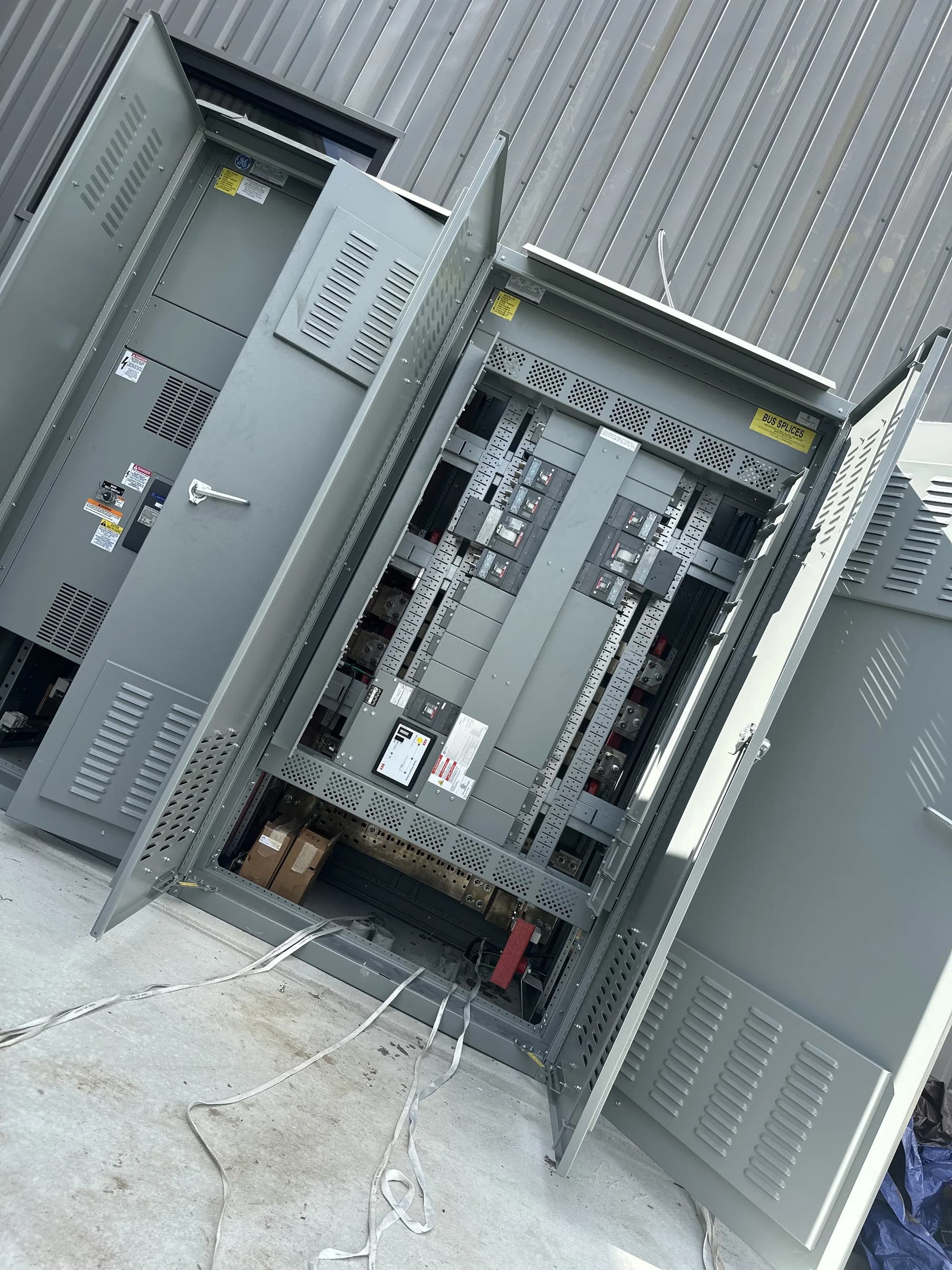
A real commercial project, start to finish.
Large-scale commercial walkthrough — what an active Babcock commercial project actually looks like.
Bid hard. Finish on schedule. Pass on the first walk.
Commercial electrical is a different game than residential. The tolerances are tighter, the documentation is heavier, the trades you’re sharing the site with don’t care if you’re late, and the GC is going to hold the schedule line whether you’re ready or not. Doing this well means showing up on day one with a full crew, the right gear in the truck, the permit pulled, and a plan to be off the site by the date in the schedule.
We bid hard — meaning we bid honest numbers, not low numbers. We don’t chase change orders. The price we put on the bid is the price we deliver, minus what the owner or GC adds in scope. When something goes sideways (we discovered the existing service can’t handle the new HVAC, the specced switchgear has a 16-week lead, the as-built doesn’t match the walls) we tell you the day we find it, not three weeks later when the schedule’s already slipping.
Markets we work in
- Retail tenant improvements — strip mall TI, anchor box fitouts, restaurant kitchens. Includes the complete service from utility drop to outlet, plus the kitchen equipment hookups and the rooftop unit feeds.
- Office buildouts — open-plan layouts, private offices, conference rooms, server closets. Includes the structured cabling for data and voice if you want it scoped together.
- Healthcare — surgical suites, exam rooms, dental clinics, imaging suites. We understand the patient-care space requirements (NEC 517) and the redundant power needs.
- Hospitality— casinos, restaurants, hotels, event venues. We work nights and weekends when the venue is dark, and we’re used to coordinating with operations to keep the lights on while the install happens around them.
- Light industrial — warehouses, fabrication shops, small-batch manufacturing. Three-phase service, motor controls, conveyor feeds, dust collection, compressed air.
- Multi-family — apartment buildings and condos. Unit feeders, house loads, common-area lighting, parking-lot poles.
How we engage
Three ways we typically come into commercial projects:
- Plan-and-spec hard bid. Standard route — GC issues an ITB through PlanHub or iSqFt, we bid against the EE-stamped drawings, the lowest qualified bidder wins. We bid often, win frequently, and finish what we bid.
- Design-build / design-assist.For owners or GCs who don’t have a full set of drawings yet, we’ll work with you to scope the electrical, pull permit-ready drawings ourselves (within Louisiana license scope), and quote turnkey.
- Direct negotiated. Repeat customers and direct owner relationships — we walk the site, talk through the scope, agree on a price, and start. Faster than hard bid, with more flexibility on substitutions.
Documentation and process
On commercial work, the paper matters as much as the install. We provide:
- Pre-construction submittals — switchgear, panels, fixtures, devices
- Permit applications and inspector coordination
- Daily reports for the duration of the project (hours, work performed, manpower)
- RFI tracking and response within 48 hours
- Change order documentation with cost backup
- Progress billing per AIA G702/G703 (or alternative format if the GC prefers)
- As-built drawings on closeout
- O&M manuals and warranty documents
- One-year workmanship warranty on all installed work
What we’ve done
Commercial work we’ve completed across SWLA includes retail tenant improvements at Prien Lake Mall, healthcare and surgical clinic buildouts with Ochsner CHRISTUS, hospitality and casino work at L’Auberge, Calcasieu Parish Sheriff’s Office facility work, and a long list of GC partnerships with Shannon Smith Construction, James Fontenot Construction, Daigle Construction & Development, and AOP Inc.
Most of our commercial work comes from repeat GC relationships — guys who know that when Babcock bids it, Babcock builds it, and they don’t have to babysit the schedule.
Insurance and licensing
- Louisiana State Licensing Board for Contractors — current and active
- Lake Charles, Sulphur, and Calcasieu Parish municipal licenses — current
- Commercial general liability — limits available on COI request
- Workers’ compensation — full coverage on every Babcock crew member
- Additional insured certificates issued same day on request
What to ask any electrician before you sign.
These questions apply to every electrical contractor in Southwest Louisiana — including us. We’d rather you call us with informed expectations than overpay anyone (us or anybody else) for substandard work.
Are you licensed in Louisiana? What's your license number?
Every electrical contractor working in LA needs a current Louisiana State Licensing Board for Contractors license. Look it up at lslbc.louisiana.gov — takes 30 seconds. If a contractor won't share their number, walk away.
Are you insured? Can I see a Certificate of Insurance?
General liability and workers' comp protect YOU if something goes wrong on your property. Ask for a COI naming you (or for commercial work, your business) as additional insured. Reputable contractors send these the same day.
Do you pull the permit, or do you expect me to?
If a contractor asks the homeowner to pull the permit, it usually means they don't want their license tied to the job. Permitted work gets inspected; unpermitted work creates insurance and resale problems.
Will the work be inspected? Who handles re-inspection if it fails?
Code-compliant work passes on the first walk. The contractor should handle inspection scheduling and fix any code corrections at no charge. Get this in writing.
Is the labor warranty in writing? For how long?
Manufacturer warranty covers the part. Workmanship warranty covers the install. The two are separate. A serious contractor warrants their labor for at least one year — most warranty for the life of the install.
What brands of materials are you using? Why these?
Square D, Eaton, Siemens, Kohler, Generac, Cree, Lithonia — these are the standards. Generic / no-name parts have higher failure rates and lower resale value. Ask the contractor to defend their material choices.
What happens if you find something unexpected behind the wall?
Honest contractors stop and tell you BEFORE doing extra work — with a written change order showing the new scope and cost. Walk away from anyone who says "don't worry, we'll figure it out as we go."
Is the quote itemized? What's NOT included?
An itemized quote shows the panel, breakers, wire, conduit, labor, permit, and any add-ons separately. "Lump sum" quotes hide the math. Equally important: ask what's NOT in the quote so you don't get surprised on day two.
Industry jargon, decoded.
Commercial-construction electrical jargon, decoded — useful for owners reading bid packages and homeowners hiring a residential contractor.
Heavy-duty enclosed assemblies of breakers, bus, and metering for commercial services 400A and up. Different beast from a residential panel — often custom-built and 10–16+ week lead time.
Invitation to Bid / Request for Proposal / Request for Quote. Three formal procurement document types GCs and owners send to contractors. ITBs are usually fixed-scope hard bid; RFPs allow more design input.
Standard American Institute of Architects forms for monthly progress billing on construction projects. G702 is the application for payment summary; G703 is the schedule of values backup. Industry standard for commercial.
Pre-construction documents the contractor sends for owner/architect approval — switchgear specs, panel cuts, fixture cuts, device specs. Approved submittals lock in what gets installed.
Request for Information. Formal mid-construction question to the GC, owner, or engineer about scope ambiguity. Tracked, dated, responded to in writing — protects everyone if the answer changes scope.
End-of-job list of items to complete or correct before final acceptance. Done after substantial completion, before final payment is released.
A percentage (usually 5–10%) of each progress payment held back by the owner until the project is complete and accepted. Released after the punchlist is closed.
Certificate of Insurance with the GC or owner listed as 'additional insured.' Required by most commercial contracts so the upstream party is covered if something goes wrong.
The milestone where the work is complete enough for the owner to occupy and use it. Triggers the warranty start date and unlocks most of the retainage.
Commercial Buildouts across our service area.
18 cities across SWLA have a dedicated commercial buildouts page. Each one covers the local housing stock, grid notes, and commercial buildouts-specific FAQs for that city.
Commercial Buildouts in Lake Charles
Headquarters
Commercial Buildouts in Sulphur
15 min from HQ
Commercial Buildouts in Westlake
10 min from HQ
Commercial Buildouts in Bell City
30 min from HQ
Commercial Buildouts in McNeese State University Area
5 min from HQ
Commercial Buildouts in University Area
5 min from HQ