
Panel upgrades
done right.
100A and 150A services upgraded to 200A or 400A. Federal Pacific and Zinsco panels replaced. Service entrances rebuilt. Code-correct, permitted, and inspected — across our 8-parish Southwest Louisiana service area.
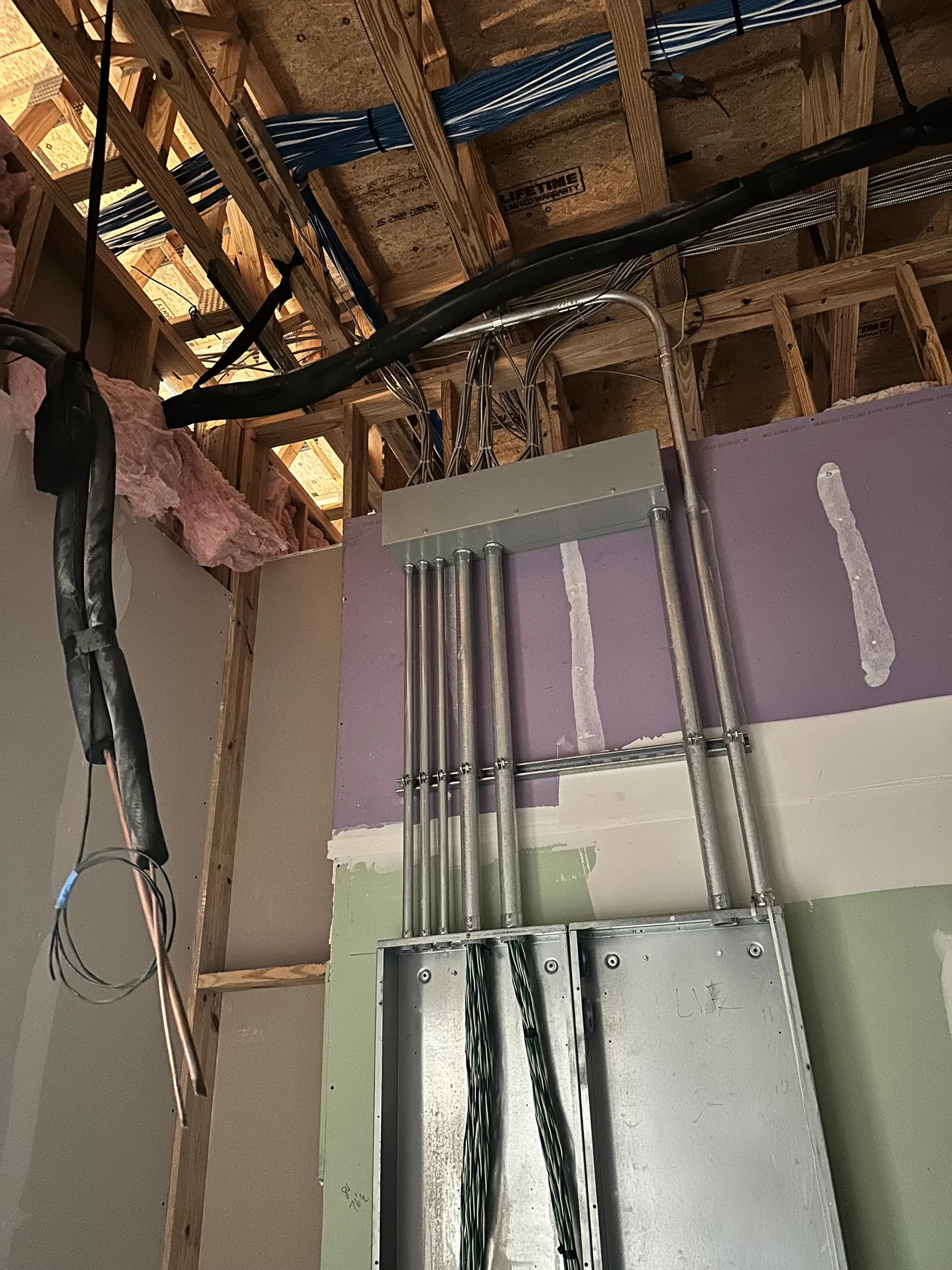
What an electrical panel upgrade actually means.
Most houses in Southwest Louisiana were wired for the loads people put on them in 1985. We don’t live in 1985 anymore. A modern home runs a 16-SEER central A/C, an electric water heater, an electric range, an electric dryer, two refrigerators, a microwave, a coffee maker that draws like a welder, and increasingly an EV charger. The panel that came with the house wasn’t built for that.
An electrical panel upgrade replaces the main breaker box (the “load center” or “panel”) with one rated for higher amperage and with more available circuits. A “service upgrade” is the bigger job — it replaces the panel and the service entrance: the wires coming in from the utility pole, the meter base on the outside of the house, the mast and weatherhead on the roof, and sometimes the grounding system. Most older homes that need a panel upgrade also need at least part of the service entrance redone.
What we’re actually replacing
The components in a typical 200A residential panel upgrade:
- The main panel (load center) — usually a Square D QO 200A 40-space
- The main breaker — 200A double-pole
- All branch-circuit breakers — single-pole, double-pole, AFCI/GFCI as required by code
- The service entrance cable from the meter base into the panel
- The grounding system — ground rods, grounding electrode conductor, water bond
- Surge protection — we install whole-home surge protection on every panel upgrade we do, included in the price
On a service upgrade, we also replace the meter base (the box on the outside of the house with the round meter), the mast and weatherhead (the pipe and fitting going up to the utility line), and we coordinate with Entergy or the local utility to pull the meter, re-attach the service drop, and re-set the meter when we’re done.
The signs you need this
You probably need a panel upgrade if any of these apply:
- The panel is full.If every breaker slot is occupied and you can’t add a circuit, you’re out of capacity.
- You see “double-tapped” breakers.Two wires landed on a single breaker terminal that’s only rated for one wire. That’s a code violation and a fire risk.
- The breakers trip on the same circuit repeatedly.If a breaker trips, that’s the breaker doing its job. If it trips regularly, the circuit is overloaded — usually because you have more load on it than the wire can handle.
- Your service is 100A or 150A and you’re adding load. EV chargers, generators, hot tubs, mini-split additions, and additions to the house all add load. Most older 100A services don’t have headroom.
- The panel is a Federal Pacific Stab-Lok or a Zinsco.Both brands have documented breaker-failure histories. Insurance carriers in Louisiana frequently won’t insure homes with these panels, or charge a surcharge. Replacing one is a real safety upgrade.
- Burn marks, melted insulation, buzzing, or warm breakers. Any of these means a connection is failing — and a failing connection in a panel is how electrical fires start.
- You smell a fishy or plasticky odor near the panel. That’s typically melting wire insulation. Call us today.
Our process
What a panel upgrade looks like start to finish:
- Free assessment.We come out, look at the existing panel, meter base, and service entrance, ask about what loads you’re adding, and run a load calculation per NEC 220. We tell you whether you need just a panel or a full service upgrade.
- Itemized quote.Firm number, in writing, with line items so you know exactly what’s included.
- Permit. We pull the electrical permit with the appropriate municipality (Lake Charles, Sulphur, Calcasieu Parish, etc.) and coordinate the inspection.
- Schedule the work. We schedule with you and coordinate the meter pull with Entergy or the local utility so power-off time is predictable.
- Install day. Power off, old panel out, new panel in, all circuits relabeled, surge protection installed, grounding verified, power back on.
- Inspection.Municipal inspector comes out, signs off, we’re done.
- Warranty. Workmanship warranted for the life of the install. Manufacturer warranty on the panel and breakers.
Pricing — the real numbers
Most contractors won’t put pricing online. We will, because we’d rather you call us with realistic expectations than blow your weekend shopping for a number.
- Straight 200A panel swap (panel only, existing service entrance OK): $2,500 – $3,500
- 200A panel + service entrance rebuild (panel, mast, meter base, weatherhead): $3,500 – $5,500
- 400A residential service: $5,500 – $9,000+
- Commercial service upgrades: Quoted per project — depends on amperage, switchgear, and utility requirements.
Every quote is firm and itemized. The only time we’d come back with a change order is if we open up a wall and find something we genuinely couldn’t see from the outside — and even then we tell you up front before doing the work.
What makes us different
We’re not a national franchise — we’re a Lake Charles–based electrical contractor with our trucks parked here, our crew living here, and our reputation on Google reviews from your neighbors. Every panel install we do gets:
- Whole-home surge protection included — not an upcharge
- Every circuit clearly labeled, not “guess and check”
- Grounding verified with a meter, not eyeballed
- Photos of the finished work for your records
- A permit and an inspection — every time
- Workmanship warranty for the life of the install
Warning signs your panel needs help.
If any of these apply to your panel, call us — or call any licensed electrician. Don't ignore them. Most are early-warning signs of a connection that's failing, and failing connections in panels are how electrical fires start.
Common panel-upgrade myths.
A bigger panel will lower my electric bill.
The panel doesn't draw power — your loads (A/C, water heater, appliances) do. A 200A panel uses the same energy as a 100A panel for the same usage. The reason to upgrade is capacity (so the panel doesn't trip when everything's running), not energy savings.
If my breakers don't trip, my panel is fine.
Federal Pacific and Zinsco panels are infamous for NOT tripping when they should — meaning a short circuit becomes a fire instead of a tripped breaker. A panel that 'never trips' isn't reassuring; it might mean the breakers can't trip.
I can just add a sub-panel to get more circuits.
Sometimes — if your main service has capacity. But most older 100A homes are already near service capacity; adding a sub-panel doesn't add amperage, just splits what you have. We run a load calc to tell you which approach fits your house.
Panel upgrades are a DIY project to save money.
Even if you're confident with wiring, the utility has to pull the meter, inspectors require licensed installs for re-energization, and most home insurance policies become invalid for unpermitted electrical work. The savings disappear the first time something needs to be re-pulled or re-inspected.
What to ask any electrician before you sign.
These questions apply to every electrical contractor in Southwest Louisiana — including us. We’d rather you call us with informed expectations than overpay anyone (us or anybody else) for substandard work.
Are you licensed in Louisiana? What's your license number?
Every electrical contractor working in LA needs a current Louisiana State Licensing Board for Contractors license. Look it up at lslbc.louisiana.gov — takes 30 seconds. If a contractor won't share their number, walk away.
Are you insured? Can I see a Certificate of Insurance?
General liability and workers' comp protect YOU if something goes wrong on your property. Ask for a COI naming you (or for commercial work, your business) as additional insured. Reputable contractors send these the same day.
Do you pull the permit, or do you expect me to?
If a contractor asks the homeowner to pull the permit, it usually means they don't want their license tied to the job. Permitted work gets inspected; unpermitted work creates insurance and resale problems.
Will the work be inspected? Who handles re-inspection if it fails?
Code-compliant work passes on the first walk. The contractor should handle inspection scheduling and fix any code corrections at no charge. Get this in writing.
Is the labor warranty in writing? For how long?
Manufacturer warranty covers the part. Workmanship warranty covers the install. The two are separate. A serious contractor warrants their labor for at least one year — most warranty for the life of the install.
What brands of materials are you using? Why these?
Square D, Eaton, Siemens, Kohler, Generac, Cree, Lithonia — these are the standards. Generic / no-name parts have higher failure rates and lower resale value. Ask the contractor to defend their material choices.
What happens if you find something unexpected behind the wall?
Honest contractors stop and tell you BEFORE doing extra work — with a written change order showing the new scope and cost. Walk away from anyone who says "don't worry, we'll figure it out as we go."
Is the quote itemized? What's NOT included?
An itemized quote shows the panel, breakers, wire, conduit, labor, permit, and any add-ons separately. "Lump sum" quotes hide the math. Equally important: ask what's NOT in the quote so you don't get surprised on day two.
Industry jargon, decoded.
A few terms you'll hear from any electrical contractor — pre-decoded so you can ask better questions.
The wires, mast, weatherhead, and meter base bringing utility power into your house. Often replaced together with the panel on a 'service upgrade.'
The single largest breaker in your panel — typically 100A or 200A. Cuts ALL power to the house when flipped. Sized to match your service.
The two metal bars inside the panel that breakers clip onto and that distribute power to every circuit. If the bus bar is damaged (corrosion, scorching), the whole panel must be replaced.
Arc-Fault Circuit Interrupter. Detects dangerous electrical arcs (a leading cause of fires in older wiring). Required by NEC on most residential bedroom + living-area circuits since 2014.
Ground-Fault Circuit Interrupter. Detects current leakage to ground (the 'shock from a hairdryer in the sink' scenario). Required in kitchens, baths, garages, and outdoor outlets.
NEC 220 method for calculating the total electrical demand of a home. Determines whether 100A, 200A, or 400A service is needed. We run one for every panel quote.
Pre-cut openings in a panel cabinet that get knocked out to install a conduit fitting. Empty knockouts must be filled with a knockout seal — open knockouts are a code violation.
Two breakers in a single slot (also called a 'cheater breaker' or 'twin breaker'). Sometimes legal, often abused as a band-aid for a full panel. Many panels won't accept tandems at all.
The overhead utility wires from the pole to your house. Owned by Entergy or your local utility, not by you. Coordination with the utility is part of any service upgrade.
Panel Upgrades across our service area.
36 cities across SWLA have a dedicated panel upgrades page. Each one covers the local housing stock, grid notes, and panel upgrades-specific FAQs for that city.
Panel Upgrades in Lake Charles
Headquarters
Panel Upgrades in Sulphur
15 min from HQ
Panel Upgrades in Moss Bluff
15 min from HQ
Panel Upgrades in Westlake
10 min from HQ
Panel Upgrades in Iowa
18 min from HQ
Panel Upgrades in DeQuincy
35 min from HQ
Panel Upgrades in Vinton
25 min from HQ
Panel Upgrades in Carlyss
25 min from HQ
Panel Upgrades in Gillis
20 min from HQ
Panel Upgrades in Hayes
25 min from HQ
Panel Upgrades in Bell City
30 min from HQ
Panel Upgrades in Graywood
15 min from HQ
Panel Upgrades in McNeese State University Area
5 min from HQ
Panel Upgrades in University Area
5 min from HQ
Panel Upgrades in Geddings Estate
15 min from HQ
Panel Upgrades in Cameron
55 min from HQ
Panel Upgrades in Hackberry
50 min from HQ
Panel Upgrades in Big Lake
60 min from HQ
Panel Upgrades in Grand Lake
50 min from HQ
Panel Upgrades in Johnson Bayou
90 min from HQ
Panel Upgrades in Creole
75 min from HQ
Panel Upgrades in Grand Chenier
80 min from HQ