Lighting that
pays you back.
Commercial LED retrofits, parking-lot poles, lighting design, residential upgrades. Most retrofits pay back in 18–36 months — after that you’re saving money every month for the life of the install.
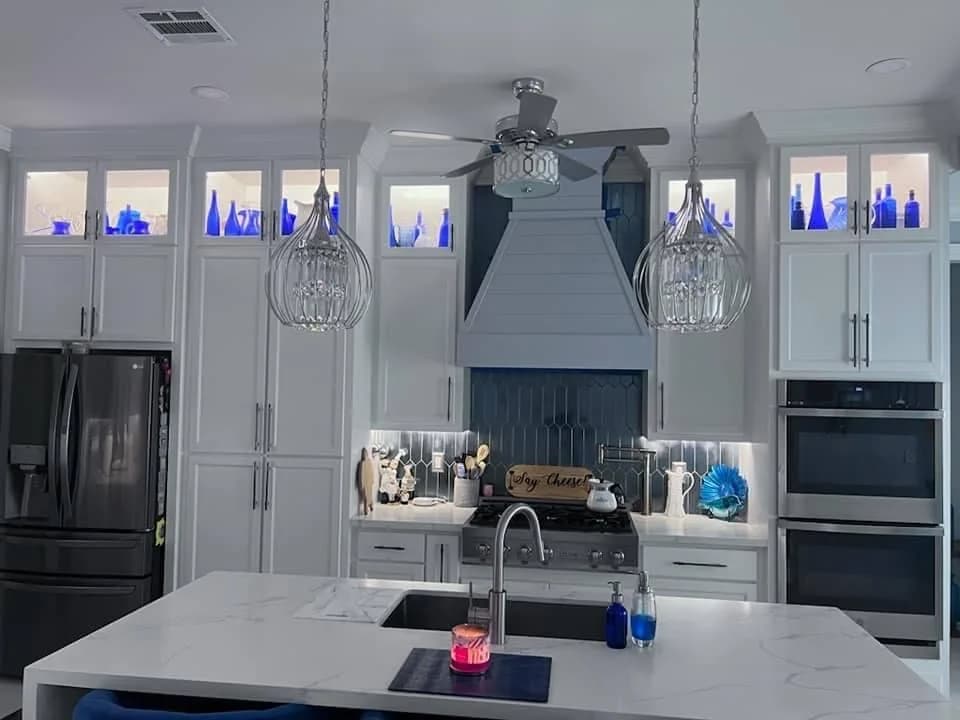
Residential-style lighting replacement, in progress.
What an active LED replacement looks like — old fixtures out, LED in.
Fluorescent vs LED. The math isn’t even close.
Same lumens, less than half the wattage, five times the life. The reason we don’t install fluorescent on a retrofit anymore.
The cheapest energy upgrade most buildings can make.
Commercial lighting retrofits are the rare home-improvement project that actually pays for itself. Swap fluorescent T8s or T12s for LED in a typical commercial space, and you cut lighting energy use by 50–70%. You stop replacing lamps and ballasts every 18 months. The light is brighter, more evenly distributed, and color-renders better — which matters in retail (better product display), restaurants (better food appeal), and offices (less eye fatigue).
The math is brutal in the LED’s favor. A 32W T8 fluorescent puts out about 2,800 lumens. A modern 12W LED tube puts out the same lumens. Same light, less than half the wattage. Multiply that by the number of fixtures in a 10,000 sq ft warehouse and the savings show up on the next utility bill.
What we retrofit
- T8 / T12 fluorescent fixtures — direct LED tube swap or full fixture replacement, depending on existing fixture condition. Direct tube swap is faster and cheaper; fixture replacement gives better optics and longer life.
- HID high-bay (metal halide, HPS) — warehouse, gymnasium, manufacturing. LED high-bay replacements are dramatically lighter on the power bill and on maintenance — no warm-up time, instant-on after a power blip.
- Recessed can lighting — retrofit kits that drop into the existing housing (fastest), or full new LED downlights when the housings are old or non-IC-rated.
- Exterior parking-lot poles — LED retrofit kits or full pole-head replacements, with photocell controls and on-demand dimming.
- Wall packs and security lighting — LED with integral photocells, dusk-to-dawn auto-on.
- Residential — recessed cans, under-cabinet, decorative, exterior landscape, smart switches and dimmers.
How payback math actually works
For a typical 10,000 sq ft retail space running fluorescent T8s on a 12-hour schedule:
- Existing usage: ~120 fixtures × 64W (2-tube T8) × 12 hrs/day × 30 days = ~2,765 kWh/month
- LED retrofit: 120 fixtures × 28W LED × 12 hrs × 30 days = ~1,210 kWh/month
- Energy savings: ~1,555 kWh/month
- At Entergy commercial rates (~$0.13/kWh): ~$200/month savings
- Plus reduced maintenance: no lamp + ballast replacements at $25–$45/fixture every 18–24 months
- Total annualized savings: ~$3,000–$4,500/year
- Project cost: $8,000–$12,000 for full retrofit
- Simple payback: 24–36 months
Higher-hour operations (warehouse 24/7, restaurants 16 hrs/day) pay back faster. Energy-rebate programs (when Entergy or the utility runs them) can also shorten payback by 10–20%.
Lighting design — when you need it
For most retrofits, design is straightforward — match the existing lumen/foot-candle level with a more efficient source. For new construction or major remodels, lighting design matters more:
- Foot-candle targets — IES recommendations for the use of the space (office: 30–50 fc, retail: 50–100 fc, warehouse: 20–30 fc)
- Color temperature — 3000K (warm) for hospitality and residential, 3500K–4000K (neutral) for retail and offices, 5000K (cool) for industrial and outdoor security
- Color rendering (CRI) — 80+ for general use, 90+ for retail product display and patient-care environments
- Glare control and uniformity — beam angle, lensing, fixture spacing
- Controls — occupancy sensors, daylight harvesting, scheduled dimming, low-voltage relays
Parking-lot and exterior site lighting
Parking-lot lighting is one of the fastest-payback retrofits going. HID shoebox heads pulling 320W get replaced with 120W LED equivalents — same light or better, third the power, and they last 3–5x as long. We replace the heads, the photocells, and any failed pole bases or bullets, plus we repair storm damage after named events.
Residential lighting
Whole-house LED conversions, smart switches, recessed retrofits, and accent/architectural lighting in homes across SWLA. We work to your designer’s spec or help you spec it ourselves for simpler retrofits. Smart switches we install most often: Lutron Caseta (well-supported, works standalone or with a hub) and Lutron RA2 Select for larger jobs.
Common lighting myths.
LED bulbs all look the same.
Color temperature (warm 2700K vs neutral 4000K vs cool 5000K) and color rendering (CRI 80 vs CRI 90+) make a huge difference. The wrong-color LEDs will make a kitchen look hospital-blue or a retail product display look washed out. We spec by application, not by lowest price.
If LED, then dimmable.
Not automatically. Many cheap LEDs aren't dimmer-compatible at all, and even compatible LEDs flicker or buzz on the wrong dimmer. Triac dimmers, 0–10V dimmers, and ELV dimmers all need matching driver types. Mismatched drivers = flicker. We pair them at quote time.
LED lasts forever.
LEDs degrade gradually rather than burning out — you'll lose 30% brightness over 50,000 hours. The driver (the electronic ballast inside) often fails before the LED itself. Brand-name fixtures (Cree, Lithonia) use better drivers — that's why they outlast generics 2–3×.
Lighting retrofits should pay for themselves on the energy savings alone.
They usually do — but maintenance savings often dwarf energy savings on commercial projects. Skipping the lamp+ballast replacement cycle (every 18–24 months on fluorescent) is where the bigger numbers come from. Real ROI = energy + maintenance + service-call avoidance.
What to ask any electrician before you sign.
These questions apply to every electrical contractor in Southwest Louisiana — including us. We’d rather you call us with informed expectations than overpay anyone (us or anybody else) for substandard work.
Are you licensed in Louisiana? What's your license number?
Every electrical contractor working in LA needs a current Louisiana State Licensing Board for Contractors license. Look it up at lslbc.louisiana.gov — takes 30 seconds. If a contractor won't share their number, walk away.
Are you insured? Can I see a Certificate of Insurance?
General liability and workers' comp protect YOU if something goes wrong on your property. Ask for a COI naming you (or for commercial work, your business) as additional insured. Reputable contractors send these the same day.
Do you pull the permit, or do you expect me to?
If a contractor asks the homeowner to pull the permit, it usually means they don't want their license tied to the job. Permitted work gets inspected; unpermitted work creates insurance and resale problems.
Will the work be inspected? Who handles re-inspection if it fails?
Code-compliant work passes on the first walk. The contractor should handle inspection scheduling and fix any code corrections at no charge. Get this in writing.
Is the labor warranty in writing? For how long?
Manufacturer warranty covers the part. Workmanship warranty covers the install. The two are separate. A serious contractor warrants their labor for at least one year — most warranty for the life of the install.
What brands of materials are you using? Why these?
Square D, Eaton, Siemens, Kohler, Generac, Cree, Lithonia — these are the standards. Generic / no-name parts have higher failure rates and lower resale value. Ask the contractor to defend their material choices.
What happens if you find something unexpected behind the wall?
Honest contractors stop and tell you BEFORE doing extra work — with a written change order showing the new scope and cost. Walk away from anyone who says "don't worry, we'll figure it out as we go."
Is the quote itemized? What's NOT included?
An itemized quote shows the panel, breakers, wire, conduit, labor, permit, and any add-ons separately. "Lump sum" quotes hide the math. Equally important: ask what's NOT in the quote so you don't get surprised on day two.
Industry jargon, decoded.
Lighting terms decoded — so 'foot-candles' and 'CRI' stop being mystery words.
How much light a fixture puts out, total. The right metric for comparing brightness across LED, fluorescent, and incandescent. (Watts only tells you energy use, not brightness.)
How much electricity the fixture consumes per hour. LED produces ~3× the lumens per watt of fluorescent and ~10× incandescent.
How 'warm' or 'cool' the light looks. 2700K = warm/incandescent feel (residential, hospitality). 4000K = neutral white (offices, retail). 5000K = cool/daylight (industrial, garage).
How accurately a light source renders colors compared to natural daylight. CRI 80+ is good for general use. CRI 90+ matters for retail product displays, healthcare, and food service.
Light intensity at a surface. Office: 30–50 fc. Retail: 50–100 fc. Warehouse: 20–30 fc. The IES (Illuminating Engineering Society) publishes targets by use type.
How wide a fixture spreads light. Narrow (15–25°) for accent and spotlight. Medium (35–60°) for general task lighting. Wide (90°+) for ambient downlighting.
The electronic component inside an LED fixture that converts AC mains to the DC current the LED needs. The driver is usually what fails first — not the LED itself.
The control signal type. 0–10V (most commercial), Triac (most residential), DALI (large facilities), DMX (entertainment). Dimmer + driver MUST match.
Power-over-Ethernet lighting — fixtures driven by network cable instead of line voltage. Emerging for tunable-white office systems where every fixture is individually addressable.
Lighting across our service area.
30 cities across SWLA have a dedicated lighting page. Each one covers the local housing stock, grid notes, and lighting-specific FAQs for that city.
Lighting in Lake Charles
Headquarters
Lighting in Sulphur
15 min from HQ
Lighting in Moss Bluff
15 min from HQ
Lighting in Iowa
18 min from HQ
Lighting in DeQuincy
35 min from HQ
Lighting in Vinton
25 min from HQ
Lighting in Carlyss
25 min from HQ
Lighting in Hayes
25 min from HQ
Lighting in Graywood
15 min from HQ
Lighting in McNeese State University Area
5 min from HQ
Lighting in University Area
5 min from HQ
Lighting in Geddings Estate
15 min from HQ