
Kohler generators.
Sized for SWLA storms.
We’re a Kohler Home Energy Authorized Dealer — factory-trained on the products, authorized to sell and install the full residential and commercial lineup, and backed by Kohler’s 5-year warranty on whole-home standby. We also install Generac when it’s the right fit. Slab, gas, electrical, transfer switch — all handled.
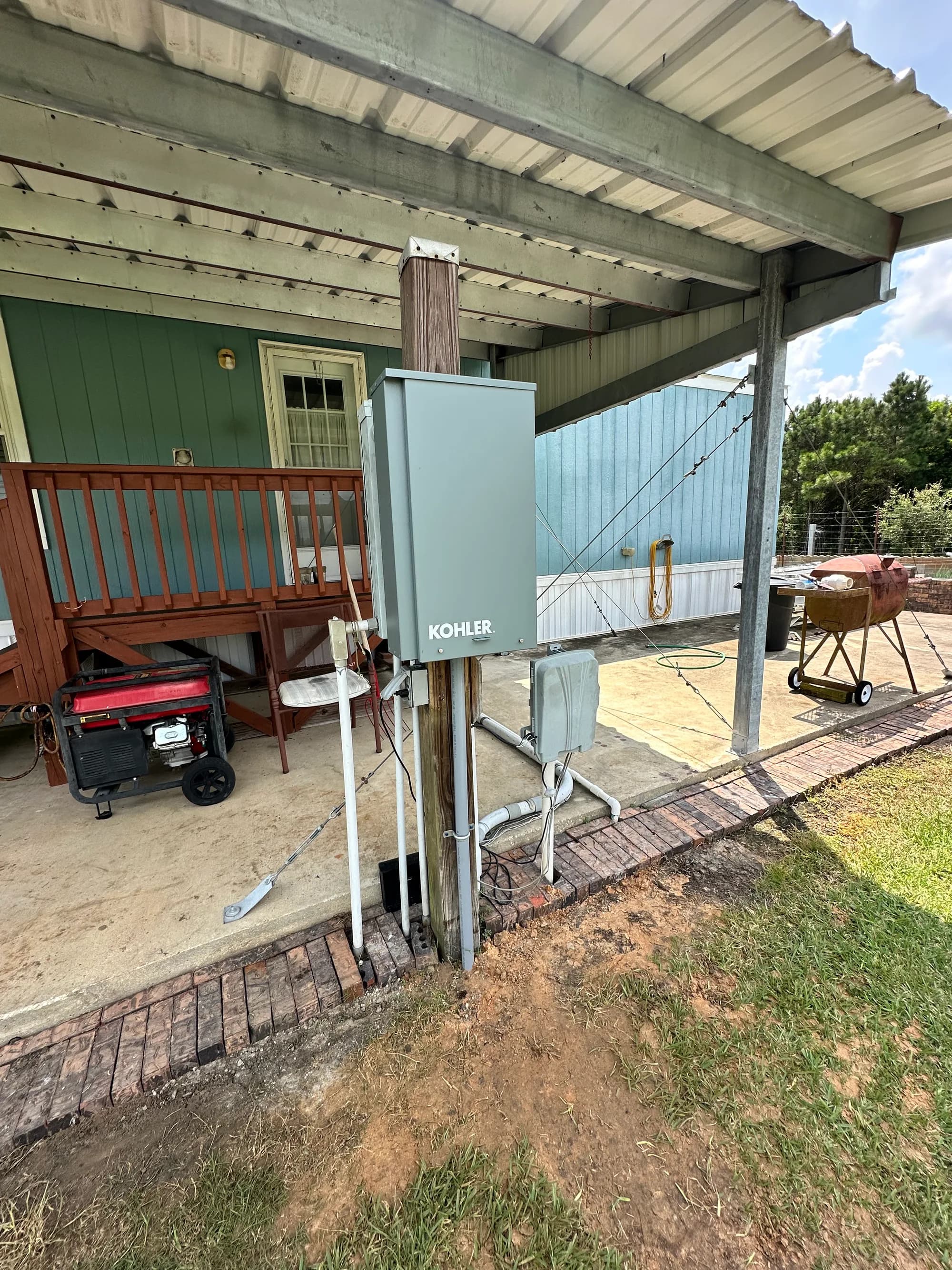
We don’t panic when the grid does.
Rita. Ike. Laura. Delta. Every storm season in Southwest Louisiana is a reminder that grid power is a suggestion, not a guarantee. Two weeks without power for Rita. Multiple weeks of patchy power across Calcasieu and Cameron after Laura and Delta. The grid in this part of Louisiana is going to keep getting hit, and the only way around it is on-site standby power that runs whether the utility lines do or not.
A whole-home standby generator sits outside your house like a small A/C condenser. When the grid drops, it senses the outage, fires up in about ten seconds, and the transfer switch automatically shifts your house from utility to generator. You barely know it happened — the lights blink and come back. When grid power restores, the transfer switch shifts back, the generator runs a five-minute cool-down, and shuts off until next time.
Babcock Electric is a Kohler Home Energy Authorized Dealer
The Kohler Home Energy Authorized Dealer program is by invitation only. To carry the badge, our techs are factory-trained on the residential and commercial lineup, the install standard is held to Kohler’s spec, and we register every unit we install with Kohler so the warranty and service history follow the customer for the life of the generator. That means:
- Factory-direct pricing on the units— we don’t buy Kohler standby generators through a distributor markup; you get the authorized-dealer price.
- Full 5-year, 2,000-hour Premium Limited Warranty on Kohler residential standby (10kW–60kW) — covering parts, labor, and dealer travel for the full warranty period. Registered to your name when we commission the unit. Warranty work is performed by a Kohler-authorized service center; we coordinate the call and the parts.
- Annual maintenance plansbuilt around Kohler’s service interval recommendations — oil + filter + battery test + full exercise log before each storm season.
- Generation-to-generation continuity — Kohler honors authorized-dealer installs and service records across ownership changes, which matters when a home with a generator changes hands.
Why Kohler
Straight from a company that’s been building generators since 1920:
- Power everything in 10 seconds. A Kohler standby fires up and transfers your home in about ten seconds — A/C, heat, sump pump, refrigerator, and the rest, all at once.
- PowerBoost™ technology.Kohler’s proprietary tech lets 10–38kW units accept a heavy load (an A/C compressor kicking on, a sump pump cycling) without dropping power to anything else in the house. That’s the difference between a generator that hiccups when the A/C starts and one that doesn’t.
- Built to outlast the outage. Heavy-duty engines (KOHLER Command PRO, KG-series) engineered for continuous standby duty, not portable use. Liquid-cooled on the larger residential and commercial units.
- Quieter at the same kW. The 14RCA runs at about 67 dBA at 23 ft during normal operation — about as loud as a refrigerator from across a room.
- Corrosion-resistant aluminum enclosure on most models — matters in Louisiana, where salt air, humidity, and storm exposure age cheap enclosures fast.
- Premium 5-year warranty — covers parts, labor, and dealer travel for the full period. Most competitors warrant parts only.
What we install — the Kohler residential lineup
We sell and install the full Kohler Home Energy lineup. The right size depends on your load — we run a load calculation per NEC 220 as part of every quote. As a rough guide:
| Generator size | Best fit | Typical loads covered |
|---|---|---|
| 10–14 kW | Smaller home, essentials only | Furnace fan, refrigerator/freezer, sump pump, lighting, well pump, TV/internet, garage door |
| 15–25 kW | Most SWLA homes | Everything in 10–14kW + central A/C, security, water heater, washing machine, electric range |
| 26–48 kW | Larger homes, two A/Cs, full electric | Everything in 15–25kW + clothes dryer, dishwasher, microwave, toaster oven, full kitchen |
| 49–150 kW | 200A+ services, large homes, small commercial | Extensive power requirements, three-phase commercial |
Specific Kohler residential models we install most often in SWLA: the 14RCA, 20RCA, 26RCA, and the liquid-cooled 24RCLA / 30RCLA / 38RCLC / 48RCLC / 60RCLB for larger homes and small commercial. For commercial standby above 60kW we quote the KG-series (KG80R, KG100R, KG125R, 150ERESC).
The KOHLER Energy Management app
Every Kohler residential standby we install can be paired with the KOHLER Energy Management app — Kohler’s mobile platform for monitoring and controlling your generator from anywhere. With it you get:
- Real-time status updates and outage alerts on your phone
- Remote start of the weekly exercise / test cycle from anywhere
- Maintenance history records for the life of the unit
- Direct in-app contact with your dealer (us) and Kohler customer support
- Historical logs that transfer with the home if you sell
Compatibility: 6kW–60kW Kohler generators (excluding the 12RES). The Wi-Fi kit installs in the unit during commissioning — we set it up before we leave site. Internet connection at the generator is required for remote monitoring.
Kohler exclusive colors and Mossy Oak patterns
Standard color is Cashmere — the off-white most generators come in. Kohler also offers exclusive color options at no upgrade cost on most residential models: French Gray Linen, Dover Gray, Pigeon Feather, Nevergreen, Admiralty, Royal Hunter Green, Brick Dust, Canyon Blue, Royal Plum, and Pegasus. Plus Mossy Oak® Shadow Grass Habitat, Break-Up Country, and Original Bottomland® patterns for camps and properties where blending matters. Tell us what you want at quote time.
Generac — when it’s the right call
Kohler is what we lead with. We also install Generac when supply, lead time, or customer preference makes it the right fit. The 22kW Generac Guardian is the most-installed whole-home generator in America — we know it inside out. We’re an authorized Generac installer; we’re the Kohler Home Energy Authorized Dealer.
We don’t install no-name imports. We don’t install portable units permanently wired to a panel — those weren’t designed for continuous duty and they fail. If you’re going to spend the money on a generator, spend it on one that’s engineered to actually run for a week straight.
Sizing — the load calc that matters
The most common mistake homeowners make is buying a generator based on the square footage of the house. Generators run loads, not floor space. We do a load calculation per NEC 220 that adds up:
- HVAC condensers (largest individual load — sometimes more than half the total)
- Electric water heater or tankless
- Electric range and oven
- Electric dryer
- Refrigeration (kitchen, garage, beverage)
- Pool / hot tub
- Lighting + outlet load
- EV charger if installed
Once we know the actual load, we size the generator with about 25% headroom. That headroom means the generator isn’t maxed out at the worst moment of the day — when the A/C compressor and the dryer and the oven are all on at once. Headroom is also what extends the engine’s life: a generator running at 60% load lasts a lot longer than one running at 95%.
Fuel — natural gas, propane, or diesel
Natural gasis the best fit if you have it. Never runs out, never refills, never gets stale. The downside is that during a major regional event (like a hurricane affecting the gas distribution system) the gas company occasionally has to shed pressure to maintain safety. Rare in SWLA, but it’s happened.
Propaneis the right fit when natural gas isn’t piped to your house — common in Cameron Parish, on rural Beauregard properties, and at camps. Sized properly, a 500-gallon tank runs a 22kW Kohler at full load for 7–10 days. We coordinate with local propane suppliers (Sparklight, Suburban, etc.) for the tank and the fill schedule.
Diesel makes sense for commercial buildings with critical loads (medical, food service, data centers, refrigerated warehouses) or where gas supply is unreliable during long outages. Diesel tanks store on-site, can be refilled by tanker, and run hard for as long as fuel lasts.
The transfer switch matters more than people think
The transfer switch is what makes the generator work automatically. It’s also where most generator installs fail — under-sized, mis-wired, or paired with a panel that can’t handle the load.
- Whole-home transfer switch — runs the entire panel. Simplest for the homeowner, requires the generator to be sized for full house load.
- Service entrance transfer switch — sits between the meter and the panel, also runs the whole house, includes the main disconnect and surge protection in one box. Our default for new installs.
- Load-managed transfer switch — runs the whole house but automatically sheds non-critical loads (one A/C, the pool pump, the EV charger) when total demand exceeds generator capacity. Lets you size the generator smaller without sacrificing essentials.
- Sub-panel transfer switch — runs only specific circuits you pre-pick (kitchen, bedrooms, A/C, well pump). Cheapest option and what we install when budget is tight.
Our process
- Free site visit, load calculation, fuel survey
- Itemized written quote — unit, slab, gas, electrical, transfer switch, permit
- Order the unit, pull the permit, schedule the slab pour
- Slab cures (typically 7 days)
- Install day — set unit, run gas, run electrical, install transfer switch
- Start-up commissioning — full test, transfer test, manual exercise programmed
- Inspection, walk-through with you, written warranty
- Annual maintenance plan available — oil + filter + full check before storm season
Real pricing for SWLA
- 14kW Generac, 8-circuit transfer, natural gas: $9,500–$12,000 installed
- 22kW Kohler or Generac, whole-home transfer, NG or LP: $13,000–$17,000 installed
- 26–32kW for large homes or two A/C systems: $18,000–$24,000+
- Commercial standby (50kW+): Quoted per project
Pricing includes the unit, the concrete slab, the gas plumbing, all electrical, the transfer switch, the permit, the inspection, and start-up commissioning. The number we give you is the number you pay.
Common generator myths.
A portable generator hardwired to my panel will run my house.
Portable generators aren't designed for continuous duty — they fail. They also lack the automatic transfer switches that prevent backfeed onto utility lines (which kills lineworkers). A permanently-installed standby is the only safe answer for whole-home backup.
Bigger generator = better.
Oversized generators run at low load, which is bad for the engine — wet stacking, fuel dilution, premature failure. Right-sized at ~75% of peak demand is what extends engine life. We size to your actual load, not to a square-footage rule of thumb.
Natural gas generators run forever in an outage.
True for most home outages — natural gas service rarely fails. But during major regional events, gas utilities sometimes shed pressure for safety. In SWLA this is rare, but propane is a hedge if your area has gas-line vulnerability.
Generators don't need maintenance.
They absolutely do. Engines need oil changes, filter changes, and battery checks like any motor. A generator that hasn't been exercised or serviced in a year often won't start when you need it. We offer maintenance plans for this exact reason.
What to ask any electrician before you sign.
These questions apply to every electrical contractor in Southwest Louisiana — including us. We’d rather you call us with informed expectations than overpay anyone (us or anybody else) for substandard work.
Are you licensed in Louisiana? What's your license number?
Every electrical contractor working in LA needs a current Louisiana State Licensing Board for Contractors license. Look it up at lslbc.louisiana.gov — takes 30 seconds. If a contractor won't share their number, walk away.
Are you insured? Can I see a Certificate of Insurance?
General liability and workers' comp protect YOU if something goes wrong on your property. Ask for a COI naming you (or for commercial work, your business) as additional insured. Reputable contractors send these the same day.
Do you pull the permit, or do you expect me to?
If a contractor asks the homeowner to pull the permit, it usually means they don't want their license tied to the job. Permitted work gets inspected; unpermitted work creates insurance and resale problems.
Will the work be inspected? Who handles re-inspection if it fails?
Code-compliant work passes on the first walk. The contractor should handle inspection scheduling and fix any code corrections at no charge. Get this in writing.
Is the labor warranty in writing? For how long?
Manufacturer warranty covers the part. Workmanship warranty covers the install. The two are separate. A serious contractor warrants their labor for at least one year — most warranty for the life of the install.
What brands of materials are you using? Why these?
Square D, Eaton, Siemens, Kohler, Generac, Cree, Lithonia — these are the standards. Generic / no-name parts have higher failure rates and lower resale value. Ask the contractor to defend their material choices.
What happens if you find something unexpected behind the wall?
Honest contractors stop and tell you BEFORE doing extra work — with a written change order showing the new scope and cost. Walk away from anyone who says "don't worry, we'll figure it out as we go."
Is the quote itemized? What's NOT included?
An itemized quote shows the panel, breakers, wire, conduit, labor, permit, and any add-ons separately. "Lump sum" quotes hide the math. Equally important: ask what's NOT in the quote so you don't get surprised on day two.
Industry jargon, decoded.
A few generator-specific terms — pre-decoded.
Permanently installed, runs on natural gas or propane, automatically starts when grid power drops. The category we install. Different from a portable.
The device that switches your house from utility to generator power. Automatic transfer switches (ATS) do it without intervention; manual transfer switches (MTS) require flipping a lever.
kW measures real power consumed (what your loads actually use). kVA measures apparent power (volts × amps). Generators are rated in both; for residential single-phase, you can treat them roughly equal.
Kohler's proprietary motor-starting tech (10–38kW units) that lets the generator accept large loads like an A/C compressor without dropping power to the rest of the house.
A transfer switch that automatically sheds non-critical loads (one A/C, the pool pump, the EV charger) when total demand exceeds what the generator can deliver. Lets you size smaller without sacrificing essentials.
The weekly 5-minute test run a standby generator does on its own to verify it'll start and run when the grid drops. Disrupts neither the grid nor your house.
Automatic Transfer Switch installed between the meter and the panel — runs the whole house, includes the main disconnect and surge protection in one box. Our default for new installs.
How loud the generator is at 23 ft. A 14kW Kohler runs about 65 dBA — quieter than a refrigerator from across a room.
How much gas pressure the generator needs at the inlet to run at full load. Matters for sizing the gas line. Listed on the generator spec sheet, given to your gas plumber.
Generators across our service area.
34 cities across SWLA have a dedicated generators page. Each one covers the local housing stock, grid notes, and generators-specific FAQs for that city.
Generators in Lake Charles
Headquarters
Generators in Sulphur
15 min from HQ
Generators in Moss Bluff
15 min from HQ
Generators in Westlake
10 min from HQ
Generators in Iowa
18 min from HQ
Generators in DeQuincy
35 min from HQ
Generators in Vinton
25 min from HQ
Generators in Carlyss
25 min from HQ
Generators in Gillis
20 min from HQ
Generators in Hayes
25 min from HQ
Generators in Bell City
30 min from HQ
Generators in Graywood
15 min from HQ
Generators in Geddings Estate
15 min from HQ
Generators in Cameron
55 min from HQ
Generators in Hackberry
50 min from HQ
Generators in Big Lake
60 min from HQ
Generators in Grand Lake
50 min from HQ
Generators in Johnson Bayou
90 min from HQ
Generators in Creole
75 min from HQ
Generators in Grand Chenier
80 min from HQ